Table of Contents
TL;DR
TL;DR: This article explains why the iPhone 13 Pro Max was a well-engineered flagship, focusing on the A15 Bionic chip, LTPO ProMotion display, sensor-shift camera stabilization, and strong battery life. Its main takeaway is that the phone’s performance, efficiency, and imaging improvements come from several hardware systems working together rather than one standout feature alone.
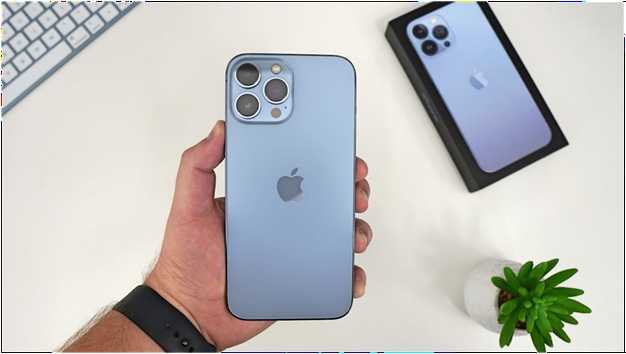
iPhone 13 Pro Max an Engineering Teardown
Apple’s marketing hype often conceals very specific engineering solutions. The iPhone 13 Pro Max is a good opportunity to explore what’s actually going on underneath the hood: how the display’s adaptive refresh rate works, why sensor-shift stabilization is better than traditional OIS, and what the chip’s 5-nanometer process technology actually does.
A15 Bionic chip: 5-nm process technology and asymmetric core architecture
Under the hood is the Apple A15 Bionic chip, manufactured using a 5-nanometer process. The processor’s architecture is asymmetric: the six CPU cores are divided into two high-performance cores (up to 3.22 GHz) and four energy-efficient ones. This is classic big.LITTLE logic—heavy tasks like rendering and computational photography are handled by the powerful cores, while background processes like syncing and notifications are delegated to energy-efficient ones, which consume significantly less power for comparable tasks.
The Pro Max has a five-core GPU, compared to the quad-core GPU in the standard iPhone 13. This difference is no accident: the larger screen and higher resolution require more processing power to render frames, especially at 120Hz.
A separate unit is the 16-core Neural Engine, capable of processing up to 15.8 trillion operations per second. This unit doesn’t perform regular CPU or GPU calculations; it’s specialized for machine learning tasks such as facial recognition, real-time computational photography, and speech processing. Offloading these tasks to a dedicated coprocessor saves energy compared to running them on a general-purpose CPU.
The A15 Bionic in the iPhone 13 Pro has an AnTuTu score of around 846,000. This explains why, several years after its release, the phone still handles modern apps without any noticeable lag.
Display: Super Retina XDR with LTPO matrix
The iPhone 13 Pro Max has a 6.7-inch OLED ProMotion display with a resolution of 2778×1284 pixels and a density of 458 ppi. Its main technological difference from previous generations is the LTPO (Low-Temperature Polycrystalline Oxide) substrate, which physically allows for variable refresh rates from 10 to 120 Hz, rather than simply switching between fixed values.
This is the engineering logic behind ProMotion: when reading static text, the refresh rate drops to 10 Hz, saving battery life, and when scrolling or gaming, it rises to 120 Hz for maximum fluidity. Without LTPO, such a range would be unachievable—conventional TFT substrates are incapable of such a wide and rapid refresh rate switching without display artifacts.
The display boasts up to 1000 nits of brightness in standard mode and 1200 nits when playing HDR content, a 25% increase over the previous generation. The Ceramic Shield protective glass features ceramic nanocrystals embedded in the glass structure, and dual ion-exchange tempering technology creates two layers of compressive stress instead of one, significantly increasing resistance to impact cracking.
Camera: Triple module with dual OIS
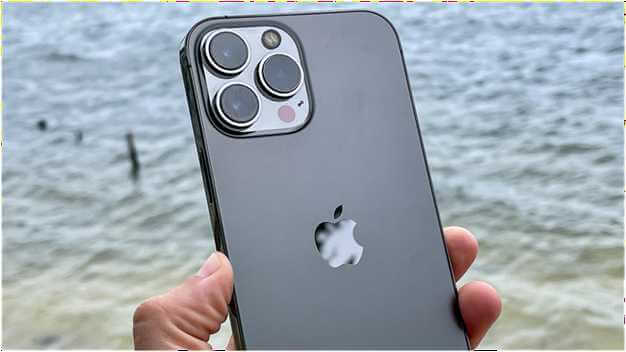
The Pro camera system includes three 12 MP modules: wide-angle (f/1.5), ultra-wide-angle (f/1.8, 120° field of view), and telephoto (f/2.8) with 3x optical zoom. Optical zoom ranges from 0.5x to 3x, and digital zoom reaches up to 15x.
The key engineering difference of this generation is sensor-shift optical image stabilization (OIS) on the wide-angle camera. Unlike traditional OIS, which stabilizes the lens assembly, the image sensor itself physically moves. This provides higher shake compensation amplitude and improved stability when shooting video on the go. This technology first appeared on the iPhone 12 Pro Max and has now been extended to the more compact Pro body.
The telephoto and wide-angle cameras also received classic OIS—or image stabilization. This means two of the three modules feature image stabilization, which is unusual for smartphones of that generation.
Cinema Effect mode uses real-time neural network processing of scene depth to simulate the shallow depth of field of a professional video camera—and allows you to change focus after shooting, since the depth data is saved in the file.
For professional filming, Apple ProRes recording with 4:2:2 chroma subsampling is available. This preserves significantly more color information than standard H.264, which is critical for color correction in post-production. 128GB versions are limited to ProRes recording in 1080p, while 256GB and higher versions support full 4K.
Battery and autonomy
The iPhone 13 Pro Max’s 4352 mAh battery provides up to 28 hours of continuous video playback—a significant improvement over the previous generation. This battery life increase is achieved through a combination of factors: a more energy-efficient 5nm chip, an adaptive LTPO display frequency that reduces idle load, and a physically larger battery housed in a case optimized for internal packaging. Wired charging is available at up to 27W, with support for MagSafe reverse wireless charging.
Communications and sensors
Connectivity options include Lightning (USB 2.0), 5G, Wi-Fi 6 (802.11ax) with MIMO support, Bluetooth 5.0, an ultra-wideband UWB module for precise location of other Apple devices, and a full suite of navigation systems—GPS, GLONASS, and Galileo. Face ID works via the TrueDepth camera in conjunction with the A15 Bionic’s neural network processing—the module projects a dot map of your face and compares it to a stored model.
FAQ
Q1: What makes the iPhone 13 Pro Max different from the regular iPhone 13?
The Pro Max adds a more powerful A15 Bionic variant, a five-core GPU, a larger 6.7-inch LTPO ProMotion display, and a more advanced camera system with sensor-shift stabilization.
Q2: What is ProMotion on the iPhone 13 Pro Max?
ProMotion is Apple’s adaptive refresh-rate technology, which can move from 10 Hz up to 120 Hz depending on what you’re doing, helping balance smoothness and battery life.
Q3: Why is the A15 Bionic important?
The A15 Bionic is built on a 5-nanometer process and uses an asymmetric core design, which helps the phone handle demanding tasks efficiently while saving power during lighter use.
Q4: What is sensor-shift optical image stabilization?
It is a camera stabilization system where the image sensor moves instead of the lens assembly, improving stability for photos and video.
Q5: How good is the battery life?
The article says the iPhone 13 Pro Max’s 4352 mAh battery can deliver up to 28 hours of continuous video playback, helped by the efficient chip and adaptive display.
Q6: Does the phone support professional video features?
Yes. The article mentions Apple ProRes recording, which preserves more color detail than standard H.264 and is useful for post-production work.
iPhone 13 Pro Max: Conclusion
From a technical perspective, the iPhone 13 Pro Max exemplifies how several solutions work together: the LTPO display reduces power consumption, and the 5nm chip adds performance headroom without increasing the TDP, resulting in a noticeable increase in battery life even with a more demanding display. For its generation, it was one of the most cohesive engineering platforms on the market.